A damp patch that keeps returning after rain, bubbling paint near the ceiling or a musty smell in one corner of a room can all point to water seepage. The difficulty is that the place where moisture becomes visible is not necessarily where the water entered the building.
Water can travel through concrete pores, cracks, joints, screed, wall cavities and interfaces between different building materials before appearing somewhere else indoors. That is why repeatedly repainting a stain or sealing the most obvious surface often provides only temporary relief.
Singapore’s climate makes good water management especially important. The Meteorological Service Singapore records an average of 171 rain days a year, with a long-term mean annual rainfall of 2,113.3 mm for 1991-2020. Mean annual relative humidity is around 82%, and humidity can reach 100% during prolonged periods of rain.
Those conditions expose roofs, external walls, balconies and other building elements to frequent moisture. Indoor wet areas such as bathrooms present a different challenge because their waterproofing systems need to contain water from regular use.
The right response to water seepage therefore begins with one question:
Where is the water actually coming from?
A lasting repair should address that source rather than simply hide the visible symptom.
Water Seepage, Water Leakage and Condensation Are Not the Same Problem
These terms are often used interchangeably, but distinguishing them can make diagnosis easier.
Water seepage generally refers to moisture moving gradually through porous materials, cracks, joints or failed waterproofing systems.
Water leakage can be a broader term that includes seepage as well as more obvious water escape from plumbing, roofs or other defects.
Condensation is different. Moisture forms when humid air meets a sufficiently cool surface. In air-conditioned spaces, this can sometimes create damp-looking areas even when no rainwater or plumbing water is entering the structure.
The repair changes depending on which problem is present.
A leaking pipe needs plumbing repair. Condensation may require attention to ventilation, insulation or air-conditioning conditions. Rain entering through a façade needs an external-wall repair. A failed bathroom waterproofing system may require work to the wet area itself.
Calling every damp patch “waterproofing failure” risks choosing the wrong solution.
Why Water Seepage Happens in Singapore Buildings
There is rarely one universal cause. The likely source depends on the property, where the moisture appears and whether the problem is linked to rainfall or normal water use.
Ageing Wet-Area Waterproofing
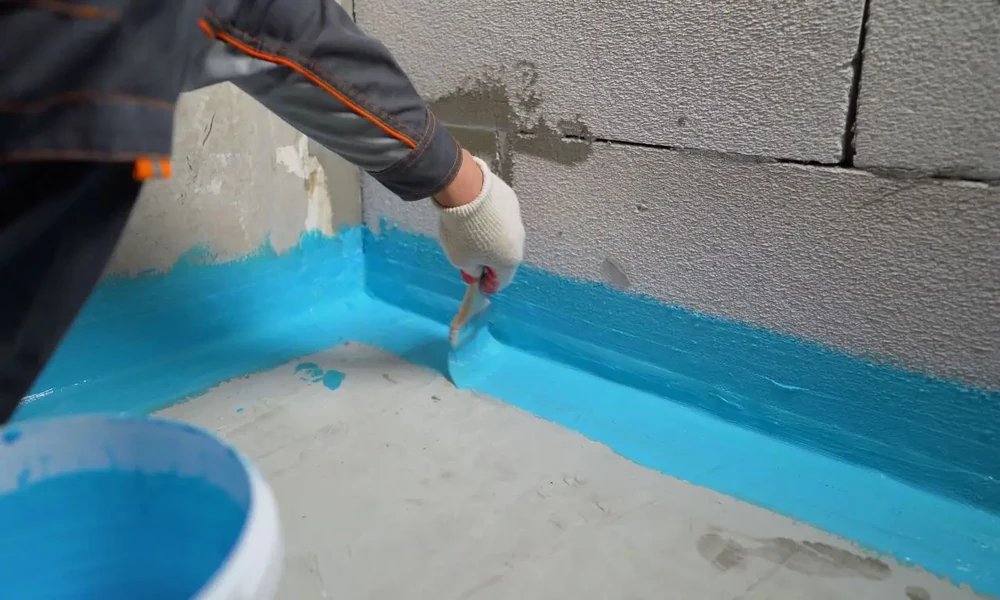
Bathrooms and toilets rely on waterproofing beneath the finishes to prevent water passing through the floor slab.
HDB states that ceiling leaks between flats commonly occur because of wear and tear to the waterproof membrane and screed in the floor slab, particularly in toilets and bathrooms.
When those layers deteriorate, moisture can migrate through the slab and appear on the ceiling of the flat below.
This is different from water leaking from a pipe, even though the symptom may look similar.
Cracks and Joints
Concrete and other building materials move over time because of shrinkage, temperature changes, loading and other factors.
Cracks can sometimes become water pathways.
Junctions between walls and floors, construction joints, expansion joints and penetrations around pipes are also common areas to inspect because they involve changes in material or geometry.
But seeing a crack does not prove that it is the leak source.
A contractor should establish whether moisture is actually travelling through it before recommending injection or sealing.
Roof Membrane Deterioration
Flat roofs depend on both waterproofing and drainage.
A membrane may deteriorate through weather exposure, physical damage, movement or poor detailing around penetrations and joints.
Water can then travel beneath the membrane or through the concrete before becoming visible indoors.
Drainage problems can make matters worse. If outlets are blocked or falls are inadequate, rainwater may remain on the roof instead of draining efficiently.
External-Wall Seepage
Walls facing heavy or wind-driven rain can develop seepage through cracks, ageing coatings, sealant failures or defects around windows and other openings.
The internal damp patch may appear near the ceiling and be mistaken for a roof leak.
Timing can provide a clue. If the problem appears mainly during heavy rain from a particular direction, the external wall should be considered during diagnosis.
Balcony and Planter-Box Defects
Balconies combine rain exposure with floor traps, joints and waterproofing beneath tiles.
Water can enter through deteriorated joints or failed waterproofing and travel laterally beneath the finish.
Planter boxes can be harder to diagnose because soil and landscaping conceal the waterproofing system while keeping it exposed to prolonged moisture.
Plumbing Leaks
A hidden pipe leak can mimic waterproofing failure.
If staining continues regardless of rainfall and does not correspond with bathroom-floor use, plumbing should remain part of the investigation.
Applying waterproof coating to a wall does not fix a leaking pipe inside it.
Concrete Deterioration
Persistent moisture can also occur alongside deteriorated concrete.
This should not automatically be treated as a waterproofing-only problem.
Where concrete is cracked, loose or spalling, the substrate may need to be repaired before or together with the waterproofing work.
8 Warning Signs of Water Seepage
Water seepage does not always begin with visible dripping. Earlier clues can be subtler.
1. Recurring Damp Patches
A patch that disappears during dry weather and returns after rain strongly suggests an unresolved moisture source.
The location can help guide investigation, but it does not necessarily identify the exact entry point.
2. Bubbling or Peeling Paint
Moisture behind paint can weaken adhesion and cause blistering, flaking or peeling.
Painting the area again may improve its appearance temporarily without resolving the water path.
3. Yellow or Brown Ceiling Stains
Discolouration on ceilings is common with water leakage.
In HDB flats, staining beneath a toilet or bathroom may indicate inter-floor seepage from the unit above, although a contractor should still investigate before assuming the waterproof membrane is responsible.
4. Musty Odours
Persistent moisture can encourage mould growth and create a stale or musty smell, particularly in poorly ventilated spaces.
HDB notes that untreated ceiling leaks may contribute to mould growth and can also damage electrical items.
5. Efflorescence
White, powdery or crystalline deposits on masonry or concrete can form when moisture moves dissolved salts towards the surface and evaporates.
Efflorescence indicates moisture movement but does not identify the source by itself.
6. Cracked or Swollen Finishes
Timber finishes, skirting, plaster or cabinetry close to recurring moisture may swell, distort or deteriorate.
These effects should be treated as evidence of continued moisture exposure rather than repaired cosmetically first.
7. Rust or Spalling Around Concrete
Corrosion staining or loose concrete deserves attention.
Where reinforcing steel has corroded and caused surrounding concrete to break away, concrete repair may be necessary alongside any work intended to stop the moisture source.
8. Water Appearing Only During Specific Conditions
Patterns can be diagnostically valuable.
A wall that becomes wet only after intense rain suggests a different problem from a bathroom ceiling that becomes damp after prolonged shower use.
Record when the seepage appears. That information can help a contractor narrow the likely source.
HDB Inter-Floor Seepage: Who Is Responsible?
Water seepage between HDB flats has a specific repair framework that should not be confused with ordinary private-property waterproofing.
HDB states that when ceiling leakage occurs between two flats, the owners are responsible for maintaining their respective flats, including the floor and ceiling slab. If repair to the slab is needed, the two neighbours generally arrange the work and split the cost involved.
HDB’s suggested process begins with the lower-floor owner approaching the neighbour above, discussing possible causes and arranging a joint contractor inspection where necessary.
The contractor then confirms the likely source and recommends the repair method.
Top-Floor Leakage Is Different
If water enters a topmost-floor HDB unit from the block roof, the roof is common property maintained by the Town Council.
The resident should contact the Town Council for rectification rather than automatically commissioning private roof-waterproofing work.
Leaks originating from other areas of common property may likewise require Town Council involvement.
That distinction can save homeowners from appointing the wrong party.
Repairing HDB Ceiling Seepage: More Than One Method Exists
HDB’s current guidance is useful because it does not pretend that one waterproofing technique suits every ceiling leak.
It states that contractors should recommend a method based on the severity of the leak and the owners’ needs, and that some cases may require more than one repair method.
Re-Screeding
HDB identifies re-screeding as its recommended method for suitable inter-floor seepage.
The process involves removing the existing floor tiles and screed, preparing the area, applying a waterproof membrane, installing a new waterproof screed and reinstating the floor finishes.
Because the waterproofing layer is exposed and rebuilt, this is more invasive than a surface treatment.
It may nevertheless be appropriate when deterioration is widespread.
Local Repair Around Floor Waste
Where leakage is concentrated around the floor waste, HDB also describes more localised repair methods.
These can involve removing the tiles and screed around the floor waste, repairing the concrete interface and reinstating the drainage detail.
PU Injection
Polyurethane injection, or PU grouting, is another recognised repair option.
The method involves injecting polyurethane material into suitable cracks, joints or voids to help seal a water pathway.
PU injection is useful when the confirmed defect is compatible with injection.
It should not automatically be treated as a replacement for an extensively failed bathroom waterproofing membrane.
Flood Infusion
HDB also recognises Flood Infusion among the additional methods homeowners may explore with contractors.
The technique is based on crystallisation treatment intended to reduce water movement through pores and capillary paths within suitable concrete.
Singapore contractor Allstar Waterproofing & Services, for example, currently provides Flood Infusion alongside PU injection and other wet-area waterproofing options. Its own published guidance appropriately notes that the repair still needs to match the actual defect rather than treating one method as universal.
Overlay Waterproofing Membrane Systems
HDB additionally lists Overlaying Waterproofing Membrane Systems as another possible approach.
Overlaying can reduce the amount of demolition where the existing surface is stable and compatible with the proposed system.
It is less suitable when tiles, screed or the underlying substrate are already failing.
Is Non-Hacking Waterproofing Always Better?
No.
A less invasive repair can be attractive because it reduces demolition, noise and reinstatement. But “no hacking” should describe a suitable method, not determine the diagnosis.
A non-hacking approach may make sense when the leak pathway is localised, the existing substrate remains sound and the selected treatment can genuinely reach the defect.
More invasive work may be justified when:
- waterproofing failure is extensive;
- screed has deteriorated;
- tiles have debonded;
- drainage falls need correction;
- the substrate requires repair; or
- previous surface treatments have repeatedly failed.
HDB’s own guidance supports this balanced view by recognising both complete re-screeding and several less invasive alternatives.
The useful question is not “Can you avoid hacking?”
It is “Will avoiding hacking still repair the actual source?”
Roof Seepage: Look at Drainage as Well as Waterproofing
A leaking roof does not automatically need another coat of waterproofing.
A proper roof investigation should consider:
- existing membrane condition;
- cracks and open joints;
- roof penetrations;
- parapets;
- flashings;
- gutters and outlets;
- signs of ponding;
- previous repair areas; and
- the roofing material itself.
Flat concrete roofs need an effective waterproof barrier, but they also need water to drain properly.
Ponding around low areas or blocked outlets can expose waterproofing to prolonged moisture and may indicate a drainage defect that deserves attention alongside membrane repair.
Metal and tiled roofs require another approach. Metal-sheet leakage may involve fasteners, corrosion, laps or flashing, while tiled roofs can leak through cracked tiles, ridge details or valleys.
The repair should follow the roof construction rather than begin with one preferred coating.
External-Wall Seepage Needs a Façade Diagnosis
When rain enters through an external wall, repairing the roof will not resolve the leak.
Likely façade defects can include:
- cracks;
- ageing joint sealant;
- deteriorated wall coatings;
- defective window interfaces;
- construction joints; and
- service penetrations.
High-rise repairs can also involve access challenges.
Scaffolding, mobile access equipment or rope-access methods may be required depending on height and location.
These requirements should appear in the quotation rather than being added unexpectedly after work begins.
Diagnosing Water Seepage: Tools Help, but Interpretation Matters More
Modern leak investigations may use moisture meters, thermal imaging, controlled water testing or other diagnostic methods.
These tools can be useful, but they should not become marketing props.
A moisture meter can show differences in moisture content or relative readings.
Thermal imaging may identify temperature patterns that warrant further investigation.
Water testing can sometimes help reproduce a leak.
None of these automatically proves where water entered.
The contractor still needs to interpret the evidence in the context of the building.
Three questions are particularly useful:
What did the investigation find?
How does that finding explain the visible seepage?
Why does the proposed repair address that pathway?
If those questions cannot be answered clearly, the technology has not solved the diagnostic problem.
When PU Injection Makes Sense-and When It Does Not
PU injection is widely used because it can treat suitable water pathways inside concrete with comparatively limited surface disruption.
According to Allstar’s current technical guidance, its PU-injection process involves pressure-injecting polyurethane into appropriate cracks, pores, joints or honeycombed concrete. The material reacts with moisture and expands to help seal the path.
This can make injection appropriate where a specific concrete defect has been confirmed.
It is less likely to solve:
- a leaking pipe;
- defective roof flashing;
- widespread bathroom membrane failure;
- poor balcony drainage;
- loose tiles and defective screed; or
- deteriorated external-wall sealant.
Asking “How much is PU injection?” before establishing that PU injection is suitable puts the method ahead of the diagnosis.
Mould, Stains and Damaged Paint Are Symptoms-not the Repair Target
One of the easiest mistakes is treating what can be seen rather than what is causing it.
Removing mould, replastering a wall or repainting a ceiling may still be necessary after a leak is fixed.
But doing those things first can hide the symptom while the structure remains wet.
The correct sequence is usually:
identify the source, stop the water, allow the affected area to dry appropriately, repair damaged finishes and then redecorate.
If mould or deterioration is substantial, additional professional advice may be needed depending on the condition of the area.
Water Seepage and Spalling Concrete Should Not Be Confused
Persistent moisture can exist alongside concrete deterioration, but waterproofing and concrete repair are separate scopes.
Spalling occurs when steel reinforcement corrodes and the expansion of the corrosion products causes surrounding concrete to crack or break away.
Where loose concrete or exposed reinforcement is present, repairing only the surface waterproofing does not restore the damaged concrete.
A contractor should be willing to distinguish between:
stopping the water, and
repairing damage the water or corrosion has already contributed to.
More serious structural defects may also require assessment beyond a waterproofing contractor’s normal scope.
Choosing a Water-Seepage Specialist in Singapore
The contractor-selection process should focus on diagnosis and scope rather than promotional claims such as “guaranteed leak-free.”
Ask for the Suspected Source
The contractor should explain where it believes the water originates.
A quotation saying only “waterproofing works” provides little information.
Check Whether the Method Fits the Defect
If PU injection is recommended, ask where the injectable crack or joint is.
If Flood Infusion is recommended, ask why the concrete is suitable.
If hacking is proposed, ask what needs to be removed and why.
If a roof membrane is recommended, ask what failed in the existing system.
Understand BCA Registration Correctly
BCA’s Contractors Registration System is a nationwide construction-firm registry used for public-sector procurement and firms employing construction S Pass or Work Permit holders, among other purposes. BCA explicitly states that private-sector construction work alone does not automatically require CRS registration, although other requirements may apply.
For waterproofing specialists, CR13 is the relevant Waterproofing Installation workhead.
As of September 2026, BCA’s official directory lists Allstar Waterproofing & Services Pte Ltd under CR13 Waterproofing Installation, Grade L1, with an expiry date of 1 July 2027.
That is useful independently verifiable information, but it should not be interpreted as BCA guaranteeing the outcome of a particular repair.
Compare the Written Scope
A useful quotation should clarify:
- areas being treated;
- suspected defect;
- repair method;
- surface preparation;
- hacking or demolition;
- reinstatement;
- access requirements;
- materials or system;
- number of visits;
- exclusions; and
- warranty terms.
Without those details, comparing quotations purely by price can be misleading.
Read the Warranty
A warranty is useful only when its scope is understood.
Check which treated area it covers, what types of recurrence qualify, what is excluded and whether later alterations can invalidate it.
For example, Allstar currently publishes a one-year warranty on repair works, with extended warranty options available for discussion, together with free on-site inspection and no-obligation quotation terms. Those are company-specific service terms rather than a Singapore-wide industry standard.
How Much Does Water Seepage Repair Cost in Singapore?
There is no credible single price that covers water-seepage repair generally.
The cost of injecting one localised crack is fundamentally different from re-screeding a bathroom, treating a high-rise façade or replacing a roof membrane.
Important cost factors include:
- source and severity of seepage;
- treated area;
- property type;
- accessibility;
- repair method;
- hacking and disposal;
- reinstatement;
- scaffolding or specialist access;
- concrete repair;
- testing;
- number of visits; and
- warranty scope.
This is why one contractor’s published price should not be treated as “the Singapore market rate.”
Compare quotations only after confirming that the contractors are proposing broadly equivalent work.
Can Water Seepage Be Fixed Permanently?
Some defects can be repaired very effectively, but “permanent” or “guaranteed forever” should be treated cautiously.
Buildings continue to move and age. New cracks can form. Sealants deteriorate. Other contractors can damage waterproofing during later works. A repaired leak can also be followed years later by an unrelated leak nearby.
A more credible objective is to repair the identified defect correctly and define what the warranty covers.
The quality of the diagnosis is therefore central to how durable the repair is likely to be.
Preventing Water Seepage Before It Becomes Serious
Not every future defect is preventable, but regular maintenance can reduce avoidable problems.
For roofs, keep drainage outlets and gutters clear and investigate persistent ponding.
Inspect sealants, flashing and areas around later-installed equipment.
For external walls, address developing cracks and failed joints rather than repeatedly painting over them.
HDB also advises residents to use non-corrosive detergents in toilets and bathrooms to minimise wear and tear to waterproof membranes and screed. It advises mopping rather than washing kitchen floors because HDB kitchen floors generally do not have the same waterproof membrane beneath the tiles.
Keep records of previous waterproofing work, including photographs, invoices, product details and warranty documents.
Those records can make future diagnosis substantially easier.
Frequently Asked Questions
What Is the Most Common Cause of Ceiling Seepage in HDB Flats?
HDB states that ceiling leakage between flats commonly results from wear and tear to the waterproof membrane and screed in wet areas such as toilets and bathrooms. Plumbing and other causes should still be investigated before repair.
Who Pays for Water Seepage Between Two HDB Flats?
Where repair to the slab between two flats is required, HDB states that the neighbouring owners generally arrange the repair and split the cost. If a top-floor leak originates from the block roof, the roof is common property maintained by the Town Council.
Can Water Seepage Be Repaired Without Hacking?
Sometimes. HDB recognises methods including PU injection, Flood Infusion and overlay waterproofing in addition to its recommended re-screeding method. Suitability depends on the defect, substrate and severity of leakage.
Is PU Injection Suitable for Every Water Leak?
No. PU injection can be useful for suitable cracks, joints, pores or voids in concrete. It does not automatically repair leaking plumbing, failed roof components, defective drainage or widespread membrane deterioration.
Why Does a Damp Patch Return After Repainting?
Because paint treats the visible finish rather than the water source. If moisture continues entering the wall or ceiling, the stain, blistering or mould can return after the new paint has been applied.
Does Every Waterproofing Contractor Need BCA CR13 Registration?
Not simply because it performs private-sector waterproofing work. CR13 is BCA’s Waterproofing Installation workhead under CRS. BCA states that CRS is required for purposes including public-sector projects and firms hiring construction S Pass or Work Permit holders; private work alone does not automatically create the requirement.
How Do I Know Whether My Leak Comes From the Roof or External Wall?
The timing and location provide clues, but inspection is usually needed. Water appearing mainly during wind-driven rain can suggest façade involvement, while roof defects may correspond with roof penetrations, membrane damage, flashing or drainage conditions. Water can travel before becoming visible, so the stain location alone is not conclusive.
How Long Should I Wait Before Repairing Water Seepage?
Recurring seepage should be investigated reasonably promptly rather than repeatedly covered cosmetically. HDB specifically advises neighbours to address detected ceiling leaks promptly because untreated leaks can cause further damage and mould growth.
Conclusion
Water seepage is rarely solved well by starting with the repair method.
The better starting point is the path the water took.
A recurring ceiling stain may originate from a bathroom above, a roof, external wall, crack or pipe. Similar-looking symptoms can therefore require completely different repairs.
For HDB owners, the distinction also determines responsibility: inter-floor seepage is generally dealt with jointly by neighbouring owners, while leakage from a top-floor block roof falls under Town Council-maintained common property.
Once the source has been identified, methods such as re-screeding, PU injection, Flood Infusion, overlay waterproofing, membrane replacement, façade repair or drainage correction can be evaluated on their technical fit rather than convenience alone.
For property owners who prefer professional assessment, Allstar Waterproofing & Services is one Singapore provider offering water seepage repair, wet-area waterproofing, roof work, PU injection and related concrete-repair services. Its current BCA listing shows CR13 Waterproofing Installation at Grade L1, while the company’s own current service information states more than 20 years of industry experience, over 3,000 clients served and a one-year repair warranty.
As with any contractor, those details should support-not replace-a project-specific diagnosis, written quotation and clear warranty.
The most durable repair is the one that answers three questions convincingly: where did the water enter, why did it get through, and how does the proposed work stop that specific pathway?